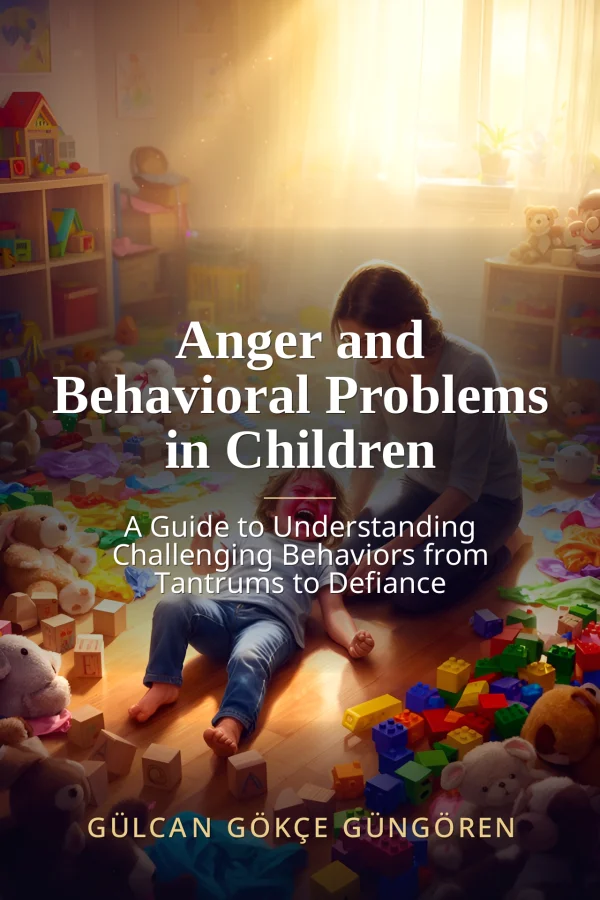
Anger and Behavioral Problems in Children: A Guide to Understanding Challenging Behaviors from Tantrums to Defiance
Gülcan Gökçe Güngören
- Category Child Development
- Format PDF
- Size 4.1 MB
- Added 23.05.2025
- Views 389
Anger and Behavioral Problems in Children offers parents, teachers, and caregivers a structured way to understand why children act out, from everyday tantrums to persistent defiance. Gülcan Gökçe Güngören approaches challenging behavior not as misbehavior to be punished but as communication to be decoded, and the book walks readers through the developmental, emotional, and environmental factors that shape how children express frustration and anger at different ages.
The guide moves from understanding to practical response. Readers learn to recognize the triggers behind outbursts, distinguish normal developmental phases from patterns that need closer attention, and respond in ways that calm rather than escalate. Chapters address tantrums, aggression, defiance, and rule-breaking, with attention to consistency, boundaries, and the role of the adult's own emotional regulation. Concrete examples and everyday scenarios help translate principles into action at home and in the classroom.
The book is written for parents, educators, and professionals who work with children and want a calm, informed approach to difficult moments. It does not promise quick fixes; instead it builds the understanding and skills needed to support children in managing strong feelings over time.
Read the Book
If the PDF does not appear, open it in a new tab.
Table of Contents
- Chapter 1 — Anger Is Not a Problem, It Is a Signal 3p. 3
- CHAPTER 1p. 5
- CHAPTER 2p. 10
- CHAPTER 3p. 15
- CHAPTER 4p. 22
- CHAPTER 5p. 27
- CHAPTER 6p. 31
- CHAPTER 7p. 35
- CHAPTER 8p. 40
- CHAPTER 9p. 46
- CHAPTER 10p. 51
- CHAPTER 11p. 55
- CHAPTER 12p. 60
A Chapter from the Book: Chapter 1 — Anger Is Not a Problem, It Is a Signal 3
CHAPTER 1 Anger Is Not a Problem, It Is a Signal Picture the moment. It's the end of a long day, you've asked your child to do something perfectly ordinary — put on their shoes, turn off the screen, come to the table — and instead of doing it, they explode. Maybe they scream. Maybe they drop to the floor. Maybe they throw the thing nearest to them, or hit out, or stand there rigid with their fists clenched, refusing you with every fiber of their body. And in that moment, the thought that arrives before any other is: what is wrong with this child? It's a fair question, and a common one. But notice what the question assumes — that anger itself is the malfunction, that a child who erupts is a child who is broken or defiant or badly raised. That assumption is where most of the struggle between parent and child actually begins. Before we can respond well to a hard moment, we have to get clear about what we're looking at. These moments wear many disguises. Sometimes the anger is loud and outward — shouting, slamming, striking out, flinging toys across the room. Sometimes it's quiet and inward — the child who goes stiff and silent, who refuses to move, who answers every request with a flat "no" and a locked jaw. Sometimes it's disguised as something else entirely: sudden tears over a trivial thing, helpless giggling, frantic silliness, a stomachache that appears right before school. All of these can be the same signal wearing different clothes. The form it takes depends on the child's age, their temperament, how much language they have, and how safe they feel expressing what they feel. Anger is a feeling, not a behavior Here is the distinction that changes everything, and it's worth sitting with for a moment: anger and aggression are not the same thing. Anger is an emotion — an internal event, like hunger or fear or joy. Aggression is a behavior — an action taken in the world. We tend to blur them together because they so often arrive at the same time, but they live in different places. One happens to your child. The other is something your child does. Why does that matter? Because you cannot responsibly ask a child to stop feeling angry. You can ask them to stop hitting. Emotions aren't obedient — they don't arrive because we've earned them or leave because we've decided they should. Telling a child "don't be angry" is like telling them "don't be hungry." It doesn't remove the feeling; it just teaches them to hide it, and hiding it doesn't make it smaller. Behavior is different. Behavior can be shaped, guided, and given better options.
Suppose that a child is told, again and again, that their anger is unacceptable. What tends to happen is not that the anger disappears but that it goes underground. It might come out later, at a smaller target — the wrong sock, the wrong cup — because the real thing was never allowed a voice. Or it might turn inward and settle into a low, flat mood, or a tight, watchful compliance that looks like good behavior but feels hollow. The feeling didn't vanish. It just lost its outlet. The behavior is pointing at something When a child erupts, the eruption is rarely about the shoes or the screen. It's a message sent in the only language the child has available at that moment. Underneath the shouting or the throwing is usually an unmet need — and the need is often one of a small handful of things. The need to feel some control over their own life. The need to be seen and taken seriously. The need for rest, food, or quiet when their body is running on empty. The need to escape something frightening or overwhelming. The need for connection, especially after a rupture. This is why the same request can produce calm one day and a meltdown the next. The behavior isn't random; it's responding to a state we may not be able to see from the outside. A child who is tired, hungry, overstimulated, or still carrying the sting of a hard morning has far less room to absorb one more demand. The demand didn't change. The child's capacity did. The tricky part is that the message is often inarticulate, and sometimes it's aimed at the wrong person. A child who had a frightening day at school may come home and yell at the person who feels safest — you. That's not a sign of bad parenting; it's a sign that home is where they feel safe enough to fall apart. It doesn't make the yelling acceptable, but it reframes what you're dealing with. You're not being attacked by a hostile person. You're being handed a signal by someone who doesn't yet have a better way to send it. Why it keeps happening If you've tried to reason with your child mid-meltdown and watched your words bounce off, you've already met the mechanism. When a child is flooded with strong emotion, the thinking, reasoning part of the brain is not available in the way it usually is. This isn't defiance or a choice to ignore you. It's that the part of the child that could take in your excellent explanation has, for the moment, stepped offline. The reasoning you offer in that state has nowhere to land.
This section is a preview taken from the book (about 909 words). To continue, read the book or download the PDF.
Book Details
- Book
- Anger and Behavioral Problems in Children: A Guide to Understanding Challenging Behaviors from Tantrums to Defiance
- Author
- Gülcan Gökçe Güngören
- Category
- Child Development
- Language
- English
- Format
- PDF · 4.1 MB
- Pages
- 65
- Words
- about 26,068
- Chapters
- 13
- Published
- Gülcan Gökçe Güngören · 23.05.2025
- Access
- Free to read and download; for personal use only, all rights belong to the author.
Frequently Asked Questions
Is the PDF of Anger and Behavioral Problems in Children: A Guide to Understanding Challenging Behaviors from Tantrums to Defiance free?
Yes. Anger and Behavioral Problems in Children: A Guide to Understanding Challenging Behaviors from Tantrums to Defiance can be read and downloaded for free on this site; no sign-up or payment is required.
How many pages is Anger and Behavioral Problems in Children: A Guide to Understanding Challenging Behaviors from Tantrums to Defiance?
Anger and Behavioral Problems in Children: A Guide to Understanding Challenging Behaviors from Tantrums to Defiance has 65 pages and about 26,068 words.
Which devices can I read Anger and Behavioral Problems in Children: A Guide to Understanding Challenging Behaviors from Tantrums to Defiance on?
It is a PDF; you can read it in your browser on a phone, tablet or computer, or download it and open it offline.
Who is the author of Anger and Behavioral Problems in Children: A Guide to Understanding Challenging Behaviors from Tantrums to Defiance?
Anger and Behavioral Problems in Children: A Guide to Understanding Challenging Behaviors from Tantrums to Defiance was written by Gülcan Gökçe Güngören; it is listed in the Child Development category.
Similar Books
 Anxiety and Fear in Children: Understanding Worries, Building Confidence, and Supporting Psychological Resilience
Gülcan Gökçe Güngören
 Children with Strong Emotional Intelligence: Recognizing Emotions, Building Empathy, and Self-Management Skills
Gülcan Gökçe Güngören
 Minds Growing Through Play: The Power of Play on Intelligence, Creativity, and Social Development
Gülcan Gökçe Güngören
 Future-Ready Children: Raising Creativity, Flexibility and Life Skills in a Changing World
Gülcan Gökçe Güngören
 The Codes of the Child's Mind: Understanding Children's World of Thought, Emotion, and Behavior
Gülcan Gökçe Güngören
 Children of the Digital Age: Growing Up Healthy with Screens, Social Media, Games, and Technology
Gülcan Gökçe Güngören