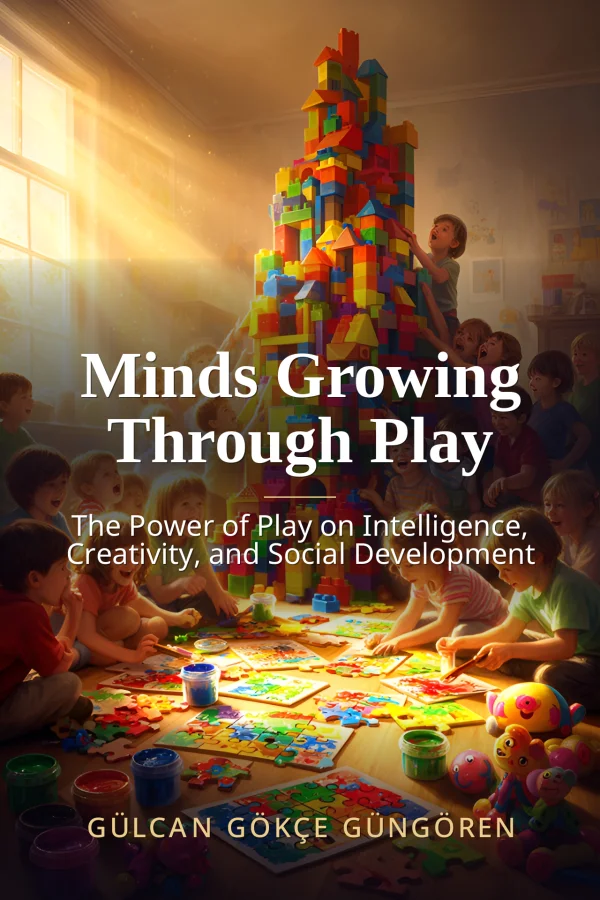
Minds Growing Through Play: The Power of Play on Intelligence, Creativity, and Social Development
Gülcan Gökçe Güngören
- Category Child Development
- Format PDF
- Size 4.6 MB
- Added 31.05.2025
- Views 437
Minds Growing Through Play explores how everyday play shapes the developing mind, connecting what children do for fun with the skills they carry into school and later life. Gülcan Gökçe Güngören draws on child development research to explain how play supports intelligence, creativity, and social growth, and why it deserves a central place in childhood rather than being treated as a break from "real" learning. The book examines different forms of play, from free imaginative games to structured activities, and shows what each contributes to thinking, problem-solving, and emotional understanding.
Across its chapters, the book looks at how play builds cognitive abilities such as attention, memory, and flexible reasoning, and how pretend play and open-ended activities nurture creativity and original thinking. It also addresses the social side: how children learn to share, negotiate, take turns, and read others' feelings through play with peers, siblings, and adults. Practical observations and examples help parents and educators recognize these developments as they happen and understand the role they can play in supporting them without over-directing.
Written for parents, teachers, and anyone involved in early childhood care and education, the book offers a clear, grounded view of play as a foundation for learning. Readers will come away with a fuller understanding of why play matters, how to create conditions that let it flourish, and how to balance guidance with the freedom children need to explore, experiment, and grow.
Read the Book
If the PDF does not appear, open it in a new tab.
Table of Contents
- Chapter 1 — What Comes to Mind When We Think of Play? 3p. 3
- CHAPTER 1p. 5
- CHAPTER 2p. 9
- CHAPTER 3p. 13
- CHAPTER 4p. 18
- CHAPTER 5p. 22
- CHAPTER 6p. 27
- CHAPTER 7p. 31
- CHAPTER 8p. 36
- CHAPTER 9p. 40
- CHAPTER 10p. 44
- CHAPTER 11p. 48
- CHAPTER 12p. 52
A Chapter from the Book: Chapter 1 — What Comes to Mind When We Think of Play? 3
CHAPTER 1 What Comes to Mind When We Think of Play? Think about the last time you watched a child play. Not a scheduled activity, not a class or a team practice — just a child, absorbed in something they chose to do. What did you actually see? Maybe it was a four-year-old stacking cushions into a wobbly tower and then knocking them down with a running jump. Maybe it was a seven-year-old narrating an elaborate story with two dolls, a hairbrush, and a cardboard box. Maybe it was a group of kids on a sidewalk arguing intensely about the rules of a game they were inventing on the spot, then playing it for ten minutes and abandoning it for something else. These scenes look different from each other, but they share something: no adult designed them, and none of them produces anything you could hold up and show someone. That last part is usually what makes adults uneasy. The Trouble With "Just Playing" When we think about play, most of us carry an unexamined assumption: that it's what children do when there's nothing more important to do. Play is the thing that happens in the gaps — after homework, before dinner, between the useful activities we've arranged for them. It's pleasant, it's natural, but it sits lower on the list than reading, swimming lessons, or whatever skill a child is currently supposed to be building. You can hear this assumption in the way we talk. A parent says, "He's had his screen time, now he needs to do something productive." A teacher hands out a worksheet and says, "We're working now, not playing." The words themselves do the work: play is the opposite of work, and work is what counts. And yet, watch the cushion tower again. The child stacking it is testing something. She's finding out how high it can go before it falls, how to balance a soft object on a hard one, how far back she needs to stand before she jumps. She's making predictions and being wrong and adjusting. Nobody would call this a lesson, but a lesson is clearly happening. The trouble is that we tend to count only the learning we can label — the alphabet, the multiplication tables — and overlook the learning that has no name. Two Faces of the Same Word There's a second assumption hiding underneath the first one, and it's worth separating out. We use "play" to describe two very different things.
The first is free play: no adult, no goal, no fixed rules. The cushion tower, the invented game that lasts ten minutes, the dolls with their complicated story. The child is in charge, and the outcome is unpredictable, sometimes chaotic, sometimes pointless. The second is structured play: a board game with instructions in the box, a sports match with a referee, a building set with a picture of the finished model on the front. These activities are playful — they're fun — but an adult designed them, and there's a right way to do them. Both have a place. But they do not do the same things for a child, and mixing them up causes us to make a quiet mistake: we assume that because an activity is fun and calls itself a game, it's delivering everything play has to offer. A child who spends an hour following the instructions in a kit has played, in a sense, but she hasn't had to invent anything. The inventive part — the part where a child decides what the rules are and why they should hold — only shows up when the adults step back. What's Really Happening Underneath So what is the child actually doing during free play? Not what she looks like she's doing, which is mostly making a mess and talking to herself. Plainly, she is running experiments. Not the formal kind with a hypothesis written down, but the same basic loop: try something, see what happens, notice the result, try again slightly differently. The cushion tower is a structural experiment; the invented game is a social experiment; the doll story is an emotional one, where she tries out scenarios and feelings in a space where nothing real can go wrong. In every version, the child is the one setting the terms. That matters more than it sounds, because being the one who chooses what to test is what makes the testing feel like play rather than a task. There's a second thing happening too, and it's why this repeats. Play is self-rewarding: a child keeps at it because the activity itself — not a sticker or a promise of dessert — is satisfying. That's an unusual engine, and it's a durable one. When we remove rewards and let a child follow her own curiosity, she stays engaged longer, returns more often, and tolerates frustration that would make her give up on a worksheet. This is why the cycle repeats so stubbornly, day after day, in every culture and every generation, even though no one is grading it. Play isn't a break from development; it is development, wearing the most comfortable clothes it owns. The child doesn't experience it as growing. She experiences it as fun. And that's exactly why it works — because she keeps coming back to it without needing to be told.
One Small Step You Can Take Today Here is a step small enough that you can do it before dinner, and real enough that it will tell you something.
This section is a preview taken from the book (about 919 words). To continue, read the book or download the PDF.
Book Details
- Book
- Minds Growing Through Play: The Power of Play on Intelligence, Creativity, and Social Development
- Author
- Gülcan Gökçe Güngören
- Category
- Child Development
- Language
- English
- Format
- PDF · 4.6 MB
- Pages
- 56
- Words
- about 22,196
- Chapters
- 13
- Published
- Gülcan Gökçe Güngören · 31.05.2025
- Access
- Free to read and download; for personal use only, all rights belong to the author.
Frequently Asked Questions
Is the PDF of Minds Growing Through Play: The Power of Play on Intelligence, Creativity, and Social Development free?
Yes. Minds Growing Through Play: The Power of Play on Intelligence, Creativity, and Social Development can be read and downloaded for free on this site; no sign-up or payment is required.
How many pages is Minds Growing Through Play: The Power of Play on Intelligence, Creativity, and Social Development?
Minds Growing Through Play: The Power of Play on Intelligence, Creativity, and Social Development has 56 pages and about 22,196 words.
Which devices can I read Minds Growing Through Play: The Power of Play on Intelligence, Creativity, and Social Development on?
It is a PDF; you can read it in your browser on a phone, tablet or computer, or download it and open it offline.
Who is the author of Minds Growing Through Play: The Power of Play on Intelligence, Creativity, and Social Development?
Minds Growing Through Play: The Power of Play on Intelligence, Creativity, and Social Development was written by Gülcan Gökçe Güngören; it is listed in the Child Development category.
Similar Books
 Anxiety and Fear in Children: Understanding Worries, Building Confidence, and Supporting Psychological Resilience
Gülcan Gökçe Güngören
 Children with Strong Emotional Intelligence: Recognizing Emotions, Building Empathy, and Self-Management Skills
Gülcan Gökçe Güngören
 Anger and Behavioral Problems in Children: A Guide to Understanding Challenging Behaviors from Tantrums to Defiance
Gülcan Gökçe Güngören
 Future-Ready Children: Raising Creativity, Flexibility and Life Skills in a Changing World
Gülcan Gökçe Güngören
 The Codes of the Child's Mind: Understanding Children's World of Thought, Emotion, and Behavior
Gülcan Gökçe Güngören
 Children of the Digital Age: Growing Up Healthy with Screens, Social Media, Games, and Technology
Gülcan Gökçe Güngören