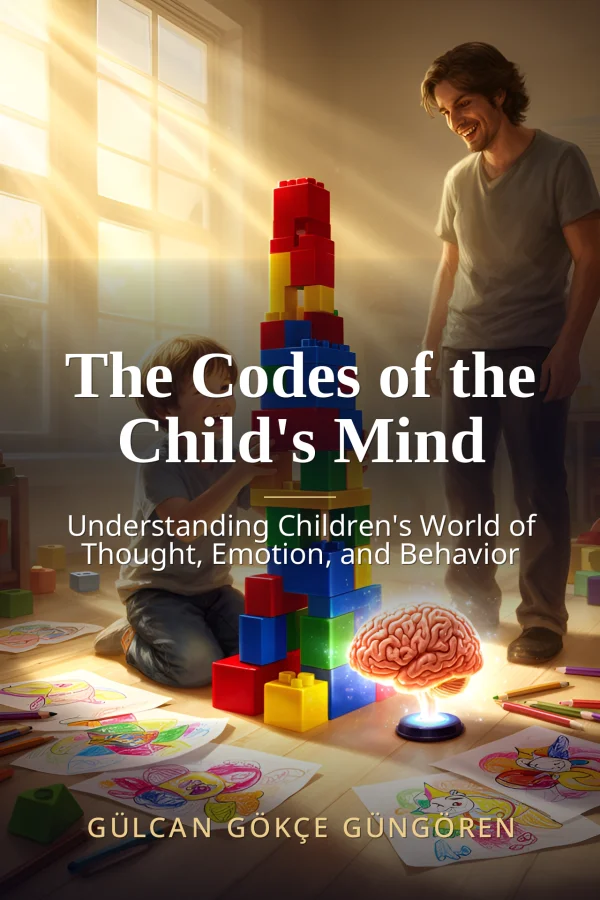
The Codes of the Child's Mind: Understanding Children's World of Thought, Emotion, and Behavior
Gülcan Gökçe Güngören
- Category Child Development
- Format PDF
- Size 4.0 MB
- Added 18.04.2025
- Views 369
The Codes of the Child's Mind offers parents, teachers, and caregivers a structured way to make sense of how children think, feel, and act. Drawing on child development research and practical observation, Gülcan Gökçe Güngören treats children's behavior not as something to be corrected quickly but as a form of communication that can be read and understood. The book examines the cognitive, emotional, and social processes behind everyday situations such as tantrums, resistance, withdrawal, and play, showing how these connect to the developmental stage a child is passing through.
The chapters move from general principles of child development to specific themes: how thought gradually takes shape in the early years, how children recognize and regulate emotions, and how behavior reflects needs that may not yet be expressible in words. Each section includes examples from daily family and classroom life, along with suggestions for responding in ways that support the child rather than simply managing the moment. Attention is also given to the role of the adult's own emotional state and to the importance of consistent, warm communication.
The book is written for parents, preschool and primary school teachers, and students of child development who want an accessible but grounded guide. Readers will come away with a clearer framework for interpreting what a child's reactions may mean, and with practical ideas for building healthier communication at home and in educational settings. It does not promise simple formulas; instead it encourages observation, patience, and a deeper understanding of the child's perspective.
Read the Book
If the PDF does not appear, open it in a new tab.
Table of Contents
- Chapter 2 — From Infancy to Adolescence: The Journey of the Mind 10p. 3
- CHAPTER 1p. 5
- CHAPTER 2p. 12
- CHAPTER 3p. 17
- CHAPTER 4p. 21
- CHAPTER 5p. 25
- CHAPTER 6p. 30
- CHAPTER 7p. 34
- CHAPTER 8p. 38
- CHAPTER 9p. 42
- CHAPTER 10p. 46
- CHAPTER 11p. 50
- CHAPTER 12p. 54
A Chapter from the Book: Chapter 2 — From Infancy to Adolescence: The Journey of the Mind 10
CHAPTER 1 The World Through a Child's Eyes: Why Do We See It Differently? Have you ever watched a child fall apart over something that seemed tiny to you? A cracker that broke in the wrong place. A sock with a seam that would not sit right. A drawing that got a smudge on it, and suddenly the whole afternoon is ruined. In the moment, it is easy to think: it is only a cracker. It is only a sock. Why all this? That question is worth taking seriously, because it points at something real. The child is not being dramatic on purpose. Something has landed differently on their side of the glass than it lands on ours, and until we understand what, our responses will keep missing the mark. The Same Moment, Two Different Sizes Suppose that you and a child are standing in the same kitchen when a glass of juice tips over. For you, this is a small mess: grab a cloth, wipe it up, pour another. For the child, the same spilled juice can feel like the end of something. Not because they love juice more than you do, but because in that moment the spill takes up their whole field of view. It is not one small event among many; it is the only event. The day is now a spilled-juice day. You can see this pattern everywhere once you start looking. A friend forgets to save them a seat at lunch, and to you it is a scheduling mix-up, while to the child it is a verdict about how much they matter. A teacher's offhand comment about neat handwriting becomes, in the child's mind, a statement about who they are. A thunderstorm at bedtime is not weather; it is something coming for them. Small events, large feelings — not because children exaggerate, but because their world is smaller, and in a smaller world the same event takes up more room. This is the first thing to hold onto: the size of an event is not fixed. It is measured against the world it lands in. Ours is broad and full of context — we have seen this problem before, we know it passes, we have a hundred other things happening. Theirs is narrow and new. A small world makes small things big. That is not a flaw in the child. It is simply the shape of a mind that has not yet collected much evidence about how the world tends to go. When Ordinary Words Land Heavy The same mismatch shows up in language. Imagine saying to a child, in an ordinary tired voice, "Not now." To you, this means: I am busy, give me a moment. To a child, the same
two words can carry a different meaning entirely — something closer to: I do not have time for you. The words did not change. The dictionary the child is reading them with is different. This is why adults are so often surprised by what children carry away from a conversation. You thought you were giving a simple instruction; the child heard a judgment. You thought you were joking; the child heard a threat. You thought you were being brief; the child heard rejection. And because the child cannot easily say, "When you said that, I understood it to mean this," the misunderstanding settles in quietly and stays. There is a second layer here, which makes it harder. Children are still learning that words are not the whole message. Adults read tone, context, timing and body language almost without noticing — we hear "fine" and know from the sigh that it is not fine. Children, especially younger ones, tend to take words at face value. If you said it, it must be true in the most literal way. A throwaway comment — "you are always so slow" — is not filed away as a passing remark. It is filed away as information about themselves. Where the Fear Comes From Then there is fear, which behaves in a similar way. An ordinary experience — a door slamming, a raised voice in the next room, a parent running late — can turn into something much larger in a child's mind. Not because the child is fragile, but because they do not yet have the background knowledge that makes an event feel contained. You know that a slammed door is a door. The child knows only that something loud and sudden happened, and that they do not know why. This is where the repeating comes in. A single frightening moment does not stay a single moment. It becomes a template. Next time something similar happens — even something faintly similar — the child's mind reaches for the earlier feeling and applies it. This is why a child who was once startled by a dog may flinch at a bark months later, and why a child who once felt dismissed may go quiet whenever a certain tone appears in a room. The reaction is not to the present event alone. It is to the pattern the mind has started to build. And here is the part that matters for us as adults: the pattern is built from the child's own interpretation, not from our intention. We may have meant nothing by it. The child's mind was not recording our intention; it was recording the feeling the moment produced, and filing that feeling under "things that happen." That filing is not a choice the child makes. It is simply how a young mind tries to make the world predictable.
This section is a preview taken from the book (about 931 words). To continue, read the book or download the PDF.
Book Details
- Book
- The Codes of the Child's Mind: Understanding Children's World of Thought, Emotion, and Behavior
- Author
- Gülcan Gökçe Güngören
- Category
- Child Development
- Language
- English
- Format
- PDF · 4.0 MB
- Pages
- 57
- Words
- about 22,432
- Chapters
- 13
- Published
- Gülcan Gökçe Güngören · 18.04.2025
- Access
- Free to read and download; for personal use only, all rights belong to the author.
Frequently Asked Questions
Is the PDF of The Codes of the Child's Mind: Understanding Children's World of Thought, Emotion, and Behavior free?
Yes. The Codes of the Child's Mind: Understanding Children's World of Thought, Emotion, and Behavior can be read and downloaded for free on this site; no sign-up or payment is required.
How many pages is The Codes of the Child's Mind: Understanding Children's World of Thought, Emotion, and Behavior?
The Codes of the Child's Mind: Understanding Children's World of Thought, Emotion, and Behavior has 57 pages and about 22,432 words.
Which devices can I read The Codes of the Child's Mind: Understanding Children's World of Thought, Emotion, and Behavior on?
It is a PDF; you can read it in your browser on a phone, tablet or computer, or download it and open it offline.
Who is the author of The Codes of the Child's Mind: Understanding Children's World of Thought, Emotion, and Behavior?
The Codes of the Child's Mind: Understanding Children's World of Thought, Emotion, and Behavior was written by Gülcan Gökçe Güngören; it is listed in the Child Development category.
Similar Books
 Anxiety and Fear in Children: Understanding Worries, Building Confidence, and Supporting Psychological Resilience
Gülcan Gökçe Güngören
 Children with Strong Emotional Intelligence: Recognizing Emotions, Building Empathy, and Self-Management Skills
Gülcan Gökçe Güngören
 Minds Growing Through Play: The Power of Play on Intelligence, Creativity, and Social Development
Gülcan Gökçe Güngören
 Anger and Behavioral Problems in Children: A Guide to Understanding Challenging Behaviors from Tantrums to Defiance
Gülcan Gökçe Güngören
 Future-Ready Children: Raising Creativity, Flexibility and Life Skills in a Changing World
Gülcan Gökçe Güngören
 Children of the Digital Age: Growing Up Healthy with Screens, Social Media, Games, and Technology
Gülcan Gökçe Güngören