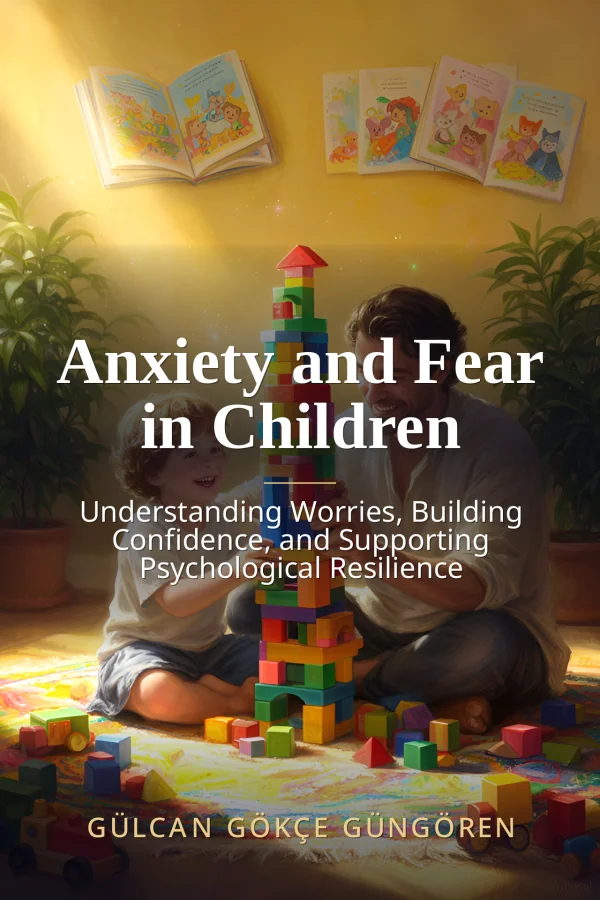
Anxiety and Fear in Children: Understanding Worries, Building Confidence, and Supporting Psychological Resilience
Gülcan Gökçe Güngören
- Category Child Development
- Format PDF
- Size 4.4 MB
- Added 27.04.2025
- Views 452
Anxiety and Fear in Children offers parents, teachers, and caregivers a clear framework for understanding the worries that shape a child's inner world. Gülcan Gökçe Güngören explains how fear and anxiety develop at different ages, why some children are more sensitive than others, and how ordinary concerns can grow into patterns that limit a child's daily life. The book distinguishes between developmentally normal fears and signals that call for closer attention, helping readers observe without jumping to conclusions.
The central work of the book is practical: recognizing the triggers and physical signs of anxiety, responding to a child's worries in ways that calm rather than dismiss, and gradually building confidence through small, achievable steps. Chapters address separation anxiety, school-related stress, social fears, sleep difficulties, and the role of parental anxiety in shaping a child's sense of safety. Each topic is presented with everyday examples and concrete suggestions for conversation and routine.
The final sections focus on psychological resilience, showing how secure relationships, emotional vocabulary, and predictable structure help children recover from setbacks. Written for families and professionals who want an informed, compassionate approach, the book avoids quick fixes and instead supports steady, patient change. Readers will come away with a better understanding of what anxiety looks like in children and with tools they can begin using immediately.
Read the Book
If the PDF does not appear, open it in a new tab.
Table of Contents
- Chapter 1 — An Overview of Fear and Anxiety in Childhood 3p. 3
- CHAPTER 1p. 5
- CHAPTER 2p. 9
- CHAPTER 3p. 14
- CHAPTER 4p. 18
- CHAPTER 5p. 23
- CHAPTER 6p. 28
- CHAPTER 7p. 32
- CHAPTER 8p. 36
- CHAPTER 9p. 41
- CHAPTER 10p. 46
- Say out loud exactly what they did, not just "good job."p. 49
- CHAPTER 11p. 50
- CHAPTER 12p. 54
A Chapter from the Book: Chapter 1 — An Overview of Fear and Anxiety in Childhood 3
CHAPTER 1 An Overview of Fear and Anxiety in Childhood Has your child ever clung to your leg at the doorway of a birthday party, refused to go upstairs alone once the lights were off, or cried at the school gate as if something terrible were happening — and you stood there wondering whether this was normal or whether something was wrong? You are not the first parent to stand in that doorway with that question. And the honest answer is that it can be both, depending on how often it happens, how intense it gets, and whether it shrinks your child's world or just brushes against it. That is what this chapter is about: learning to tell the difference. The same feeling wearing different clothes Fear and anxiety in childhood rarely announce themselves with a label. They show up as behaviour. A child who suddenly cannot sleep alone at eight years old, having slept fine at six. A child who develops a stomach ache every Sunday evening. A child who asks the same question — will you be there when I wake up? — five times before you leave the room. A child who goes quiet at the edge of a group of children rather than joining in, watching from a safe distance. Suppose a family is getting ready for the first day of school. One child is excited, chatty, laying out clothes the night before. Another is irritable, complains of a headache, and by the gate dissolves into tears. Same event, same family, same preparation — completely different responses. Neither child is being difficult. Both are having a feeling; only one of them has a feeling their body can carry comfortably. It helps to notice that fear and anxiety, in everyday language, get used up almost interchangeably, but they are not quite the same experience. Fear tends to have a target — the dark staircase, the large dog, the loud noise. Anxiety is more like a background hum: a worry about something that has not happened yet, sometimes without a clear picture of what it is. A child can often tell you what they are afraid of. Anxiety is harder for them to put into words, which is exactly why it so often comes out as a behaviour instead — the tears, the clinging, the refusal, the endless questions. What is happening underneath Underneath all of it, something quite simple and quite sensible is going on. A child's brain is built to keep them safe, and it takes a long time to finish the job. The part that sounds the
alarm — the fast, automatic, body-first part — is working from very early on. The part that can reason, weigh up evidence, and say to itself I've done this before and it was fine is much slower to mature. So when a child meets something unfamiliar or uncertain, the alarm goes off first and the explanation arrives late, if at all. This is why you cannot usually reason a frightened child out of being frightened in the moment. You can explain, calmly and correctly, that there are no monsters under the bed — and your child can believe you completely and still be unable to stay in the room alone. The alarm is not waiting for the explanation. This is not stubbornness or a failure to listen. It is the order in which the system works. Then there is the repetition, which puzzles many parents. Why does the same fear come back night after night, even after a good day? Because the alarm learns from experience, and one calm night is one data point. Each time your child avoids the thing they fear, they get relief — and relief is a powerful teacher. The brain registers: that felt better, do that again. So avoidance quietly grows, and with it the sense that the feared thing really must be dangerous, otherwise why would we work so hard to stay away from it? This is the loop worth understanding early, because it runs underneath almost every worry this book will look at — the dark, separation, school, other children, making mistakes. The feeling is real, the body responds, the child avoids, the avoidance brings relief, the relief confirms the danger, and the next time the alarm is a little quicker to sound. Nothing here is broken. It is a protective system doing its job a little too enthusiastically, and part of our work as adults is to help it calibrate. One small step you can take today Here is something you can do before the day is over, and it costs nothing. Pick one fear your child has — not the biggest one, not the one that worries you most, just a mild, everyday one. The dark hallway they won't cross alone. The neighbour they hide behind you to avoid greeting. The coat they refuse to put on without a fight on Sunday night. Then get curious about it out loud, without trying to fix it. Something like: "I've noticed you don't like going past the stairs when the lights are off. What's the worst part — the dark itself, or not knowing what's there?" And then stop talking. Let the answer be strange. Let it be "the wall looks different." Let it be "I don't know." The point is not the answer.
This section is a preview taken from the book (about 893 words). To continue, read the book or download the PDF.
Book Details
- Book
- Anxiety and Fear in Children: Understanding Worries, Building Confidence, and Supporting Psychological Resilience
- Author
- Gülcan Gökçe Güngören
- Category
- Child Development
- Language
- English
- Format
- PDF · 4.4 MB
- Pages
- 58
- Words
- about 22,708
- Chapters
- 14
- Published
- Gülcan Gökçe Güngören · 27.04.2025
- Access
- Free to read and download; for personal use only, all rights belong to the author.
Frequently Asked Questions
Is the PDF of Anxiety and Fear in Children: Understanding Worries, Building Confidence, and Supporting Psychological Resilience free?
Yes. Anxiety and Fear in Children: Understanding Worries, Building Confidence, and Supporting Psychological Resilience can be read and downloaded for free on this site; no sign-up or payment is required.
How many pages is Anxiety and Fear in Children: Understanding Worries, Building Confidence, and Supporting Psychological Resilience?
Anxiety and Fear in Children: Understanding Worries, Building Confidence, and Supporting Psychological Resilience has 58 pages and about 22,708 words.
Which devices can I read Anxiety and Fear in Children: Understanding Worries, Building Confidence, and Supporting Psychological Resilience on?
It is a PDF; you can read it in your browser on a phone, tablet or computer, or download it and open it offline.
Who is the author of Anxiety and Fear in Children: Understanding Worries, Building Confidence, and Supporting Psychological Resilience?
Anxiety and Fear in Children: Understanding Worries, Building Confidence, and Supporting Psychological Resilience was written by Gülcan Gökçe Güngören; it is listed in the Child Development category.
Similar Books
 Children with Strong Emotional Intelligence: Recognizing Emotions, Building Empathy, and Self-Management Skills
Gülcan Gökçe Güngören
 Minds Growing Through Play: The Power of Play on Intelligence, Creativity, and Social Development
Gülcan Gökçe Güngören
 Anger and Behavioral Problems in Children: A Guide to Understanding Challenging Behaviors from Tantrums to Defiance
Gülcan Gökçe Güngören
 Future-Ready Children: Raising Creativity, Flexibility and Life Skills in a Changing World
Gülcan Gökçe Güngören
 The Codes of the Child's Mind: Understanding Children's World of Thought, Emotion, and Behavior
Gülcan Gökçe Güngören
 Children of the Digital Age: Growing Up Healthy with Screens, Social Media, Games, and Technology
Gülcan Gökçe Güngören