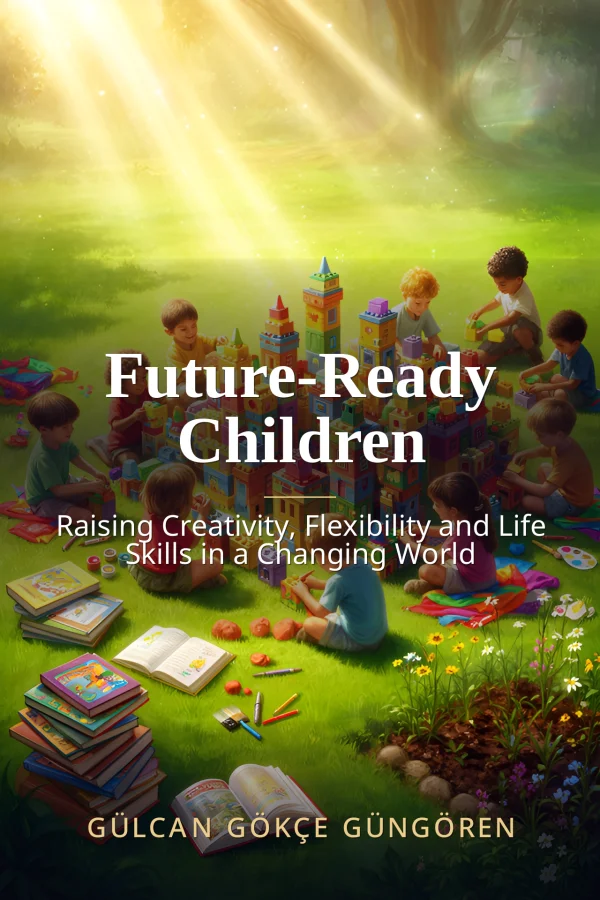
Future-Ready Children: Raising Creativity, Flexibility and Life Skills in a Changing World
Gülcan Gökçe Güngören
- Category Child Development
- Format PDF
- Size 4.8 MB
- Added 24.04.2025
- Views 370
Future-Ready Children addresses a question many parents and educators now ask: which abilities will actually matter as technology, work and society keep changing? Gülcan Gökçe Güngören argues that the answer lies less in specific technical skills than in durable human capacities — creativity, flexibility, curiosity and the everyday life skills that help children adapt to situations no one can fully predict.
The book moves from this broad perspective into practical territory. It explores how creativity can be encouraged rather than scheduled, how flexibility and resilience are built through small daily experiences, and how independence, problem-solving and emotional awareness develop when adults step back and allow children to try, fail and try again. Each chapter connects child development research to concrete suggestions that fit ordinary family life, with attention to the balance between guidance and freedom.
Written for parents, caregivers and teachers of children from early childhood through the primary years, Future-Ready Children is not a collection of shortcuts or formulas. It offers a thoughtful framework for thinking about what children need, along with realistic ideas for putting that framework into practice at home and in the classroom. Readers will come away with a clearer sense of how to support children without overprotecting them, and how to prepare them for a changing world by strengthening the qualities that remain valuable whatever the future brings.
Read the Book
If the PDF does not appear, open it in a new tab.
Table of Contents
- Chapter 1 — Why Are Ready-Made Answers Not Enough? 3p. 3
- CHAPTER 1p. 5
- CHAPTER 2p. 9
- CHAPTER 3p. 12
- CHAPTER 4p. 16
- CHAPTER 5p. 21
- CHAPTER 6p. 26
- CHAPTER 7p. 31
- CHAPTER 8p. 34
- CHAPTER 9p. 39
- CHAPTER 10p. 43
- CHAPTER 11p. 47
- CHAPTER 12p. 51
A Chapter from the Book: Chapter 1 — Why Are Ready-Made Answers Not Enough? 3
CHAPTER 1 Why Are Ready-Made Answers Not Enough? Have you ever watched a child answer a question perfectly — and then freeze the moment the question changes, even slightly? They knew the answer. They had practised it, maybe even been praised for it. But the question came at them from a different angle, and the knowledge that looked so solid a moment before suddenly had nothing to hold on to. That moment is worth paying attention to, because it isn't rare. It happens at kitchen tables and in classrooms, on the way to school and in the middle of homework. A child can name every planet in order and then sit blankly when you ask which one they'd most like to visit and why. They can recite a rule for rounding numbers and then hesitate over a shopping problem where rounding is what's needed. They can list the steps of a science experiment but look lost when the actual result is messier than the instructions promised. In each case, the same thing has happened. The child learned the answer, but not the thinking that produced it. And answers without the thinking behind them only work in the exact conditions where they were learned. What Learning Looks Like From the Inside Underneath all of this is a simple mechanism, and it's worth understanding plainly. When a child memorises a fact or a procedure, what they're building is a map of a specific route. Ask them to walk that route, and they'll do it beautifully. Ask them to find their own way to somewhere nearby, and the map is useless — not because the child is slow, but because a route is not a map of the territory. It only describes one path across it. This is why memorisation feels so effective while it's happening. The child gives the right answer, receives the pleased reaction, and feels capable. The feeling is genuine. What it measures, though, is recall, not understanding. It tells you what a child can reproduce, not what they can do when the situation shifts. And situations almost always shift. There's a second layer here too. Ready-made answers don't just leave understanding untouched; they quietly teach something of their own. If every question in a child's life arrives with an answer attached — from a textbook, a worksheet, or a quick reply from an adult — the child learns that the task is to retrieve, not to think. Over time this becomes a habit, and habits are far harder to change than facts. The child doesn't just lack practice at figuring things out; they start to believe that figuring things out isn't really part of the job. Why It Keeps Repeating
The repetition isn't anyone's fault, which is exactly why it's so hard to break. Systems tend to reward what they can measure, and correct answers are easy to count while curiosity, reasoning and persistence are not. So the child who reproduces answers smoothly gets more of the same material, and the child who stumbles on a forgotten fact starts to believe the problem is them rather than the way the learning was built. Meanwhile, the world they're being prepared for doesn't resemble the conditions of a worksheet. Most real problems don't arrive with the answer hidden in the last chapter. They arrive incomplete, ambiguous, and with more than one route through them — and the person solving them has to decide what matters and where to begin. A child can spend years becoming excellent at retrieval and still find that this particular muscle has barely been used. None of this means facts don't matter. They absolutely do — you can't reason well about things you know nothing about. The point is narrower: knowing something and being able to use it are two different abilities, and only one of them survives contact with a changing situation. The next half of this chapter looks at where that leaves us — and at what can actually be done about it. So what does that leave you with? Not a curriculum overhaul, not a new hobby to squeeze into an already full week. Something much smaller — and small is the point. The best first step is one you can take in an ordinary conversation, without announcing that anything has changed. Start With One Question a Day Pick a single, regular moment — the walk home from school, dinner, the last few minutes before bed — and in that moment, ask your child a question that has no fixed answer. Not "What did you learn today?" which invites a report, but something that asks them to think: "If you could change one rule at school, which would it be, and what might happen?" Or "What's something you're good at that nobody taught you?" Or "What's a question you've been wondering about lately?" Then let the answer come. Don't correct it, don't improve it, don't turn it into a lesson. If it's silly, be interested in the silliness. If it's half-formed, ask one follow-up — "Why that one?" — and leave it there. The whole exchange can take two minutes, and those two minutes are doing something that worksheets can't: they're showing your child that their thinking is worth hearing.
Keeping it going is the harder part, and the trick is to attach it to something that already happens reliably. A routine that depends on you remembering will last about a week. A routine that lives inside an existing moment — the same stretch of pavement, the same seat at the table — has a chance. If you miss a day, you haven't broken anything.
This section is a preview taken from the book (about 941 words). To continue, read the book or download the PDF.
Book Details
- Book
- Future-Ready Children: Raising Creativity, Flexibility and Life Skills in a Changing World
- Author
- Gülcan Gökçe Güngören
- Category
- Child Development
- Language
- English
- Format
- PDF · 4.8 MB
- Pages
- 54
- Words
- about 20,470
- Chapters
- 13
- Published
- Gülcan Gökçe Güngören · 24.04.2025
- Access
- Free to read and download; for personal use only, all rights belong to the author.
Frequently Asked Questions
Is the PDF of Future-Ready Children: Raising Creativity, Flexibility and Life Skills in a Changing World free?
Yes. Future-Ready Children: Raising Creativity, Flexibility and Life Skills in a Changing World can be read and downloaded for free on this site; no sign-up or payment is required.
How many pages is Future-Ready Children: Raising Creativity, Flexibility and Life Skills in a Changing World?
Future-Ready Children: Raising Creativity, Flexibility and Life Skills in a Changing World has 54 pages and about 20,470 words.
Which devices can I read Future-Ready Children: Raising Creativity, Flexibility and Life Skills in a Changing World on?
It is a PDF; you can read it in your browser on a phone, tablet or computer, or download it and open it offline.
Who is the author of Future-Ready Children: Raising Creativity, Flexibility and Life Skills in a Changing World?
Future-Ready Children: Raising Creativity, Flexibility and Life Skills in a Changing World was written by Gülcan Gökçe Güngören; it is listed in the Child Development category.
Similar Books
 Anxiety and Fear in Children: Understanding Worries, Building Confidence, and Supporting Psychological Resilience
Gülcan Gökçe Güngören
 Children with Strong Emotional Intelligence: Recognizing Emotions, Building Empathy, and Self-Management Skills
Gülcan Gökçe Güngören
 Minds Growing Through Play: The Power of Play on Intelligence, Creativity, and Social Development
Gülcan Gökçe Güngören
 Anger and Behavioral Problems in Children: A Guide to Understanding Challenging Behaviors from Tantrums to Defiance
Gülcan Gökçe Güngören
 The Codes of the Child's Mind: Understanding Children's World of Thought, Emotion, and Behavior
Gülcan Gökçe Güngören
 Children of the Digital Age: Growing Up Healthy with Screens, Social Media, Games, and Technology
Gülcan Gökçe Güngören