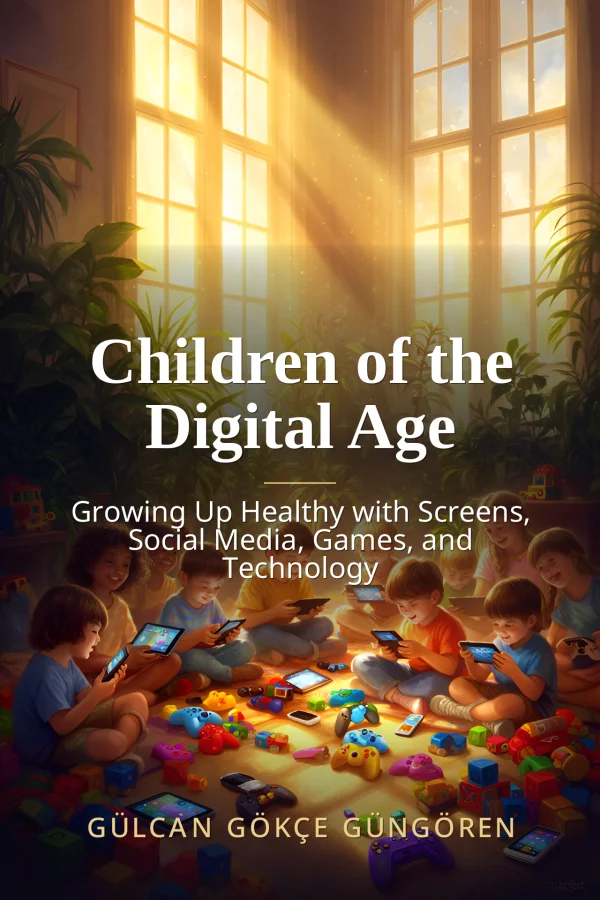
Children of the Digital Age: Growing Up Healthy with Screens, Social Media, Games, and Technology
Gülcan Gökçe Güngören
- Category Child Development
- Format PDF
- Size 4.6 MB
- Added 03.05.2025
- Views 330
Children of the Digital Age is a practical guide for parents, educators, and caregivers navigating the challenges of raising children in a world saturated with screens. Drawing on research and real-world experience, the book examines how digital technologies—from smartphones and tablets to social media and video games—shape children's development, behavior, and well-being. It offers a balanced perspective, acknowledging both the opportunities and risks that technology presents.
The book provides actionable strategies for setting healthy boundaries, fostering digital literacy, and encouraging responsible online behavior. It addresses common concerns such as screen time limits, cyberbullying, online privacy, and the impact of social media on self-esteem and mental health. Each chapter includes practical tips and conversation starters to help families build positive digital habits together.
Written for anyone involved in child development, this resource emphasizes the importance of active mediation and open communication. It guides readers in helping children develop critical thinking skills, empathy, and resilience in digital spaces. By blending research insights with everyday advice, Children of the Digital Age empowers adults to support children in growing up healthy and balanced in an increasingly connected world.
Read the Book
If the PDF does not appear, open it in a new tab.
Table of Contents
- Chapter 1 — A New Childhood: Growing Up in a Digital World 3p. 3
- CHAPTER 1p. 5
- CHAPTER 2p. 9
- CHAPTER 3p. 16
- CHAPTER 4p. 21
- CHAPTER 5p. 26
- CHAPTER 6p. 31
- CHAPTER 7p. 36
- CHAPTER 8p. 40
- CHAPTER 9p. 45
- CHAPTER 10p. 51
- CHAPTER 11p. 55
- CHAPTER 12p. 59
A Chapter from the Book: Chapter 1 — A New Childhood: Growing Up in a Digital World 3
CHAPTER 1 A New Childhood: Growing Up in a Digital World Has this happened in your home? You ask your child to put the tablet away, and a small, ordinary moment turns into a standoff. Not because anyone is cruel or careless — just because the screen is right there, and the request lands like a door being closed. Most parents I speak with describe something like this, and almost all of them feel a flicker of guilt when they do, as if the friction itself proves something has gone wrong. The trouble is that this scene shows up in a hundred different shapes, and they don't all look like trouble. Sometimes it's a child who goes quiet with headphones on while the family eats. Sometimes it's a game that gets paused for dinner and then resumed, calmly, ten minutes later — no drama at all. Sometimes it's a teenager scrolling before bed and yawning through breakfast. Sometimes it's a seven-year-old teaching a grandparent how to video call, delighted and capable. If you only watched for conflict, you'd miss most of what is happening. So it's worth asking a different question. Not "is the screen good or bad?" but "what is this device actually doing in my child's day?" A tool, a companion, a pacifier, a classroom, a stage — the same glass rectangle can be all of these within a single afternoon, and its effect depends almost entirely on which one it is being at the time. The World They Were Born Into Here is the simplest way to see the difference between your childhood and your child's. You met this technology as an adult. It arrived in your life as a thing you learned, adopted, and could, in principle, put back down. Your child met it as part of the furniture. For them, a phone is not a novelty; it is closer to a light switch — unremarkable, expected, simply there. That matters more than it sounds. When something is experienced as ordinary, we stop noticing it, and children are far less equipped than adults to examine a habit they never saw arrive. A child does not remember a time before streaming, before messaging, before a screen could answer almost any question in a second. So they don't experience these things as choices in the way you do. They experience them as the way the world works. Suppose, for a moment, an adult had to learn to see screens as new again. They'd probably look at their own habits and flinch a little. Children can't easily do that leap, because they lack the before-picture to compare against. Their normal is the screen. That is the first and most basic difference between the generations, and everything else follows from it.
When It Feels Like a Problem Notice that none of the situations above are automatically a problem. The friction, the quiet, the calm gaming, the late-night scrolling — these are ordinary textures of family life in a digital age. In themselves they tell you very little. A screen being used is not a symptom; it's a fact. What tends to separate a passing annoyance from a genuine concern is not the number of minutes. It's what happens at the edges. Does the child come back? Can they stop without a fight when the reason is real? Is there a part of the day that belongs to something else — sleep, food, people, play — and stays that way? These are the questions worth holding onto, and they are far more useful than a stopwatch. There's a reason so many parents reach for the stopwatch anyway. Counting feels concrete; it gives you something to hold. But if you watch closely, you'll notice that a child who can put the tablet down easily and one who can't may have used it for the same number of minutes. The difference is about how the habit sits in their life, not how long it lasts. Underneath the Surface So what is actually going on when a child reaches for a screen again and again? The plain explanation is that these things are built to give back quickly. A tap produces something — a sound, a picture, a small reward. The child's attention is answered almost instantly, and that instant answer is satisfying in a way that slow, quiet activities often aren't. This isn't a flaw in your child; it's how attention behaves when it meets something that responds fast. Add to this that games and apps are designed by people who want to keep the child engaged. They are not handing over a tool and stepping away; they are tuning an experience to hold a young person's interest. Sometimes that's benign, sometimes it isn't, but either way it means the situation is not a fair fight between a child and a piece of glass. There is another mind, however indirectly, pulling gently on the other side. And crucially, the pattern repeats for a simple reason: relief. When a child is bored, anxious, or unsure what to do, the screen offers the fastest exit from that uncomfortable feeling. Each time it works, the habit deepens a little. Over many repetitions, reaching for a device can become the first response to almost any feeling — a kind of automatic doorway out of the present moment. None of this makes the child weak or the parent foolish. It's the ordinary mechanics of how habits form, and it happens with all of us.
This section is a preview taken from the book (about 916 words). To continue, read the book or download the PDF.
Book Details
- Book
- Children of the Digital Age: Growing Up Healthy with Screens, Social Media, Games, and Technology
- Author
- Gülcan Gökçe Güngören
- Category
- Child Development
- Language
- English
- Format
- PDF · 4.6 MB
- Pages
- 63
- Words
- about 25,356
- Chapters
- 13
- Published
- Gülcan Gökçe Güngören · 03.05.2025
- Access
- Free to read and download; for personal use only, all rights belong to the author.
Frequently Asked Questions
Is the PDF of Children of the Digital Age: Growing Up Healthy with Screens, Social Media, Games, and Technology free?
Yes. Children of the Digital Age: Growing Up Healthy with Screens, Social Media, Games, and Technology can be read and downloaded for free on this site; no sign-up or payment is required.
How many pages is Children of the Digital Age: Growing Up Healthy with Screens, Social Media, Games, and Technology?
Children of the Digital Age: Growing Up Healthy with Screens, Social Media, Games, and Technology has 63 pages and about 25,356 words.
Which devices can I read Children of the Digital Age: Growing Up Healthy with Screens, Social Media, Games, and Technology on?
It is a PDF; you can read it in your browser on a phone, tablet or computer, or download it and open it offline.
Who is the author of Children of the Digital Age: Growing Up Healthy with Screens, Social Media, Games, and Technology?
Children of the Digital Age: Growing Up Healthy with Screens, Social Media, Games, and Technology was written by Gülcan Gökçe Güngören; it is listed in the Child Development category.
Similar Books
 Anxiety and Fear in Children: Understanding Worries, Building Confidence, and Supporting Psychological Resilience
Gülcan Gökçe Güngören
 Children with Strong Emotional Intelligence: Recognizing Emotions, Building Empathy, and Self-Management Skills
Gülcan Gökçe Güngören
 Minds Growing Through Play: The Power of Play on Intelligence, Creativity, and Social Development
Gülcan Gökçe Güngören
 Anger and Behavioral Problems in Children: A Guide to Understanding Challenging Behaviors from Tantrums to Defiance
Gülcan Gökçe Güngören
 Future-Ready Children: Raising Creativity, Flexibility and Life Skills in a Changing World
Gülcan Gökçe Güngören
 The Codes of the Child's Mind: Understanding Children's World of Thought, Emotion, and Behavior
Gülcan Gökçe Güngören