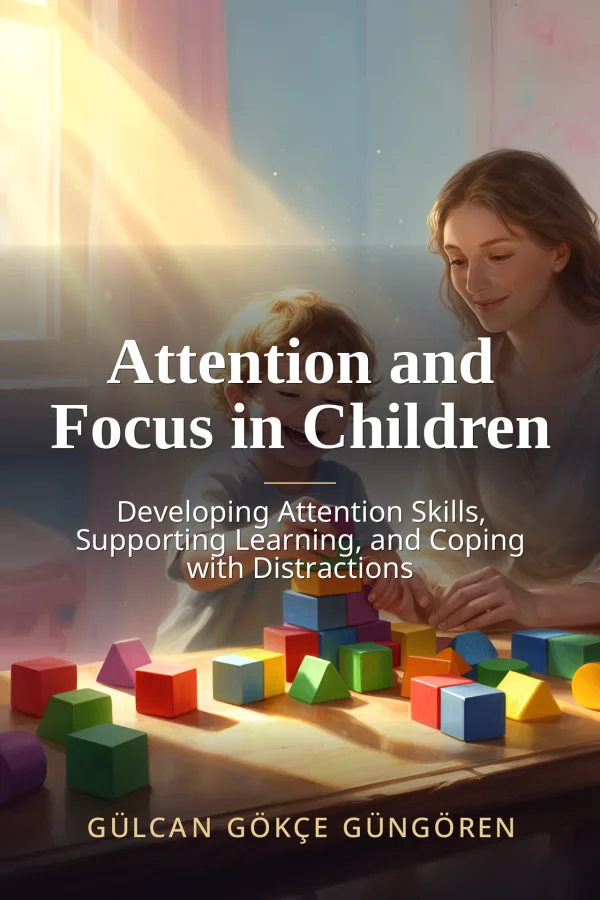
Attention and Focus in Children: Developing Attention Skills, Supporting Learning, and Coping with Distractions
Gülcan Gökçe Güngören
- Category Child Development
- Format PDF
- Size 3.4 MB
- Added 11.05.2025
- Views 261
Attention is the foundation on which learning, memory, and self-regulation are built, yet it is one of the least understood aspects of childhood development. In this book, Gülcan Gökçe Güngören examines how attention and focus develop in children, why some children struggle to sustain concentration, and what parents, teachers, and caregivers can do to support these skills at home and in the classroom. The book connects developmental research with everyday observation, explaining the different forms attention takes and how they change across childhood.
The author offers practical guidance on creating environments that support learning, structuring tasks so they match a child's capacity, and responding constructively when distraction or restlessness appears. Readers will find approaches for building attention skills gradually, recognizing when difficulty concentrating may signal something beyond ordinary distractibility, and working with schools and professionals when additional support is needed. Throughout, the emphasis is on realistic expectations and consistent, patient support rather than quick fixes.
Written in clear language and grounded in child development principles, this book is intended for parents, educators, and anyone who works with children and wants to understand attention more deeply. It provides a balanced view of what children can reasonably be expected to do at different ages and how adults can help them learn to focus, manage distractions, and engage more fully with the world around them.
Read the Book
If the PDF does not appear, open it in a new tab.
Table of Contents
- Chapter 1 — What Attention Is and Is Not 3p. 3
- CHAPTER 1p. 5
- CHAPTER 2p. 12
- CHAPTER 3p. 16
- CHAPTER 4p. 21
- CHAPTER 5p. 26
- CHAPTER 6p. 31
- CHAPTER 7p. 35
- CHAPTER 8p. 40
- CHAPTER 9p. 45
- CHAPTER 10p. 50
- CHAPTER 11p. 55
- CHAPTER 12p. 61
A Chapter from the Book: Chapter 1 — What Attention Is and Is Not 3
CHAPTER 1 What Attention Is and Is Not You've asked your child to put on their shoes. Ten minutes later, you walk past their room and they're sitting on the floor, one shoe on, completely absorbed in something else — a thread on the carpet, a toy they found under the bed, the sound of a bird outside. The shoes are forgotten. Not out of defiance. Not because they didn't hear you. Or maybe it's homework time. You sit down together, the page is open, the pencil is in hand. And within two minutes, your child is talking about something that happened at school last week, or noticing that the chair squeaks, or asking a question that has nothing to do with anything on the page. Or it's dinner. You've asked them to sit at the table. They're up again before the plate is half empty, circling the room, coming back, leaving again. Does any of this sound familiar? These situations look different from the outside, but they share a common thread: your child isn't doing what the moment seems to require of them. And the natural conclusion — the one most of us reach without thinking — is that something is wrong. That attention is missing. That if we could just get them to focus, everything would fall into place. That conclusion is understandable. But it's also where a lot of confusion starts. The shapes it takes Attention problems don't show up in one neat form. They wear different clothes depending on the day, the task, and the child. One common shape is the child who can't seem to start. The task is in front of them, but they drift — reorganizing their pencil case, sharpening pencils that don't need sharpening, asking for a glass of water. They aren't avoiding the work in any deliberate way. They just can't seem to land on it. Another shape is the child who starts fine but can't hold on. They begin with energy and interest, then somewhere in the middle, their attention slips off the track. They lose their place, forget what they were doing, or look up and realize they've been reading the same paragraph three times without taking any of it in. Then there's the child who seems to notice everything except what's in front of them. A conversation in the next room, a movement at the window, someone's footsteps in the
hallway — all of it pulls their gaze. They aren't more distractible in a character sense; their attention just keeps answering the door. And there's the shape that confuses parents most: the child who can focus for an hour on something they love — building, drawing, playing a game — but can't get through five minutes of something they don't. It looks contradictory. It isn't, and understanding why matters. What is actually going on Attention is not a single thing that you either have or don't. It's a collection of processes working together, and each of them can be strong or weak independently. Think of attention as having a few moving parts. There's the part that lets your child choose what to focus on — filtering out the rest. There's the part that keeps them there over time, holding steady against drift. There's the part that lets them hold something in mind while working with it — remembering the first half of an instruction while carrying out the second. And there's the part that stops them from acting on every impulse that arrives. These parts support each other, but they aren't the same thing. A child can be strong in one and still struggle with another. This is why the shoe situation, the homework situation, and the dinner situation aren't necessarily the same problem wearing different disguises. In each one, a different part of the system is being asked to do something specific. And in each one, the demand might be landing at a moment when that part isn't at full strength. That last point matters more than it might seem. Attention isn't a fixed setting. It shifts with how tired your child is, how much sleep they got, how hungry they are, how loud the room is, how many screens they've been looking at, and whether the task in front of them asks for a kind of focus they find easy or hard. A child who can't sit still at 7 p.m. on a school night after a full day is not showing you their capacity. They're showing you their current state. Those are different things, and confusing them leads to conclusions you'll later have to take back. Why it repeats If attention were simply a matter of willpower or good habits, it wouldn't keep happening. But the patterns you're seeing — the same situations, the same slipping, the same frustration — aren't random. They're the result of how attention naturally operates when the conditions around it aren't helping.
The brain is built to respond to what's new, what's moving, what's loud, what's emotionally interesting. That's not a flaw; it's how all of us are wired. For a child whose attention system is still developing, that pull is stronger and the counterweight — the ability to override the pull and stay with something less exciting — is still being built. So the thread on the carpet wins over the shoe. The bird wins over the homework page. The movement in the hallway wins over the dinner plate. It isn't that your child prefers those things.
This section is a preview taken from the book (about 918 words). To continue, read the book or download the PDF.
Book Details
- Book
- Attention and Focus in Children: Developing Attention Skills, Supporting Learning, and Coping with Distractions
- Author
- Gülcan Gökçe Güngören
- Category
- Child Development
- Language
- English
- Format
- PDF · 3.4 MB
- Pages
- 65
- Words
- about 24,629
- Chapters
- 13
- Published
- Gülcan Gökçe Güngören · 11.05.2025
- Access
- Free to read and download; for personal use only, all rights belong to the author.
Frequently Asked Questions
Is the PDF of Attention and Focus in Children: Developing Attention Skills, Supporting Learning, and Coping with Distractions free?
Yes. Attention and Focus in Children: Developing Attention Skills, Supporting Learning, and Coping with Distractions can be read and downloaded for free on this site; no sign-up or payment is required.
How many pages is Attention and Focus in Children: Developing Attention Skills, Supporting Learning, and Coping with Distractions?
Attention and Focus in Children: Developing Attention Skills, Supporting Learning, and Coping with Distractions has 65 pages and about 24,629 words.
Which devices can I read Attention and Focus in Children: Developing Attention Skills, Supporting Learning, and Coping with Distractions on?
It is a PDF; you can read it in your browser on a phone, tablet or computer, or download it and open it offline.
Who is the author of Attention and Focus in Children: Developing Attention Skills, Supporting Learning, and Coping with Distractions?
Attention and Focus in Children: Developing Attention Skills, Supporting Learning, and Coping with Distractions was written by Gülcan Gökçe Güngören; it is listed in the Child Development category.
Similar Books
 Anxiety and Fear in Children: Understanding Worries, Building Confidence, and Supporting Psychological Resilience
Gülcan Gökçe Güngören
 Children with Strong Emotional Intelligence: Recognizing Emotions, Building Empathy, and Self-Management Skills
Gülcan Gökçe Güngören
 Minds Growing Through Play: The Power of Play on Intelligence, Creativity, and Social Development
Gülcan Gökçe Güngören
 Anger and Behavioral Problems in Children: A Guide to Understanding Challenging Behaviors from Tantrums to Defiance
Gülcan Gökçe Güngören
 Future-Ready Children: Raising Creativity, Flexibility and Life Skills in a Changing World
Gülcan Gökçe Güngören
 The Codes of the Child's Mind: Understanding Children's World of Thought, Emotion, and Behavior
Gülcan Gökçe Güngören