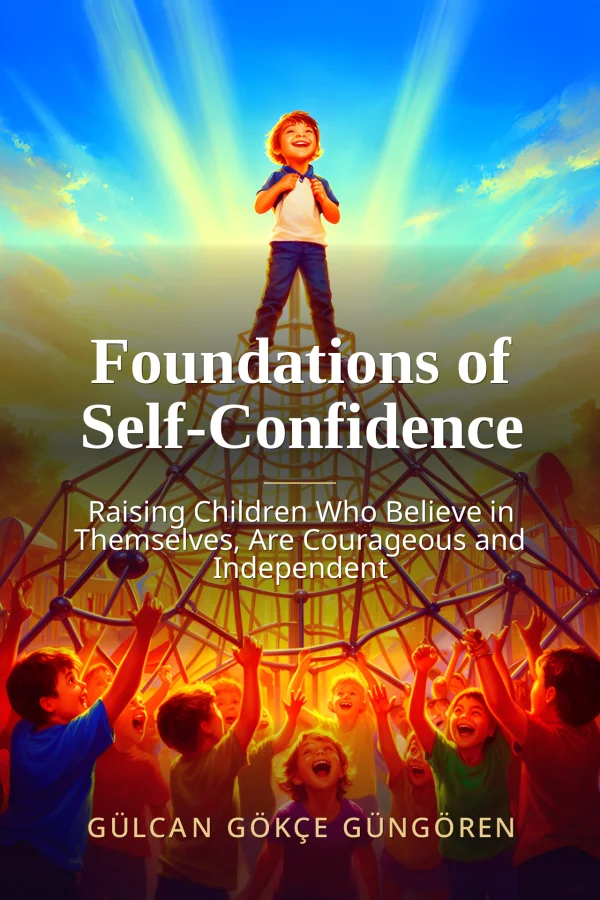
Foundations of Self-Confidence: Raising Children Who Believe in Themselves, Are Courageous and Independent
Gülcan Gökçe Güngören
- Category Child Development
- Format PDF
- Size 4.3 MB
- Added 16.05.2025
- Views 306
Foundations of Self-Confidence is a practical guide for parents and caregivers who want to understand how a child's sense of self-worth develops and what adults can do to support it. Drawing on child development principles, the book explains how confidence is built through everyday interactions: how children are spoken to, how their efforts are received, and how much room they are given to try things on their own. It treats self-belief not as a fixed trait but as something that grows gradually from experience, encouragement, and the freedom to make mistakes.
The book explores the links between confidence, courage, and independence, showing why children who trust themselves are more willing to take on challenges, handle setbacks, and make decisions. Chapters address common parental concerns such as overprotection, praise that backfires, fear of failure, and the balance between guidance and control. Parents will find concrete suggestions for fostering responsibility at different ages, responding to disappointment without undermining a child, and setting boundaries that support rather than restrict growing autonomy.
Written for parents, teachers, and anyone involved in raising children, Foundations of Self-Confidence offers a calm, realistic approach rather than quick fixes. Readers will come away with a clearer understanding of how their daily responses shape a child's inner voice, along with practical tools they can apply at home and in the classroom to help children become capable, courageous, and self-reliant.
Read the Book
If the PDF does not appear, open it in a new tab.
Table of Contents
- Chapter 1 — What Self-Confidence Is and What It Is Not 3p. 3
- CHAPTER 1p. 5
- CHAPTER 2p. 9
- CHAPTER 3p. 15
- CHAPTER 4p. 19
- CHAPTER 5p. 22
- CHAPTER 6p. 28
- CHAPTER 7p. 32
- CHAPTER 8p. 36
- CHAPTER 9p. 40
- CHAPTER 10p. 44
- CHAPTER 11p. 49
- CHAPTER 12p. 53
A Chapter from the Book: Chapter 1 — What Self-Confidence Is and What It Is Not 3
CHAPTER 1 What Self-Confidence Is and What It Is Not Have you ever watched a child step back from something they clearly wanted to try — a climbing frame, a new game, a question asked out loud in class — and wondered what stopped them? Not lack of ability. Not lack of interest. Something quieter and more internal. Maybe you've seen it in your own child. Maybe, if you're honest, you've felt a version of it yourself, standing at the edge of something new. That moment of stepping back is where self-confidence quietly reveals itself. And it's worth asking what is actually happening in it, because the answer shapes everything that follows — how a child meets opportunity, how they handle setbacks, how they decide things without waiting for someone else's nod. This chapter is about getting clear on what self-confidence really is, so the rest of the book has solid ground to stand on. The situation, in its everyday shapes Think of the forms this shows up in. A child who knows the answer but won't raise a hand. A child who starts a puzzle and abandons it the moment it gets hard. A child who asks permission for things they're perfectly capable of deciding. A child who does well on a test and says it was luck, then does badly and says it was their fault. A child who wants to join a game but hovers at the edge, waiting to be invited rather than stepping in. Then there's the quieter version: the child who seems fine on the surface but checks in constantly. "Is this right? Did I do it okay? Are you sure?" They aren't fishing for praise so much as looking for a signal — some external reassurance that they haven't gone wrong. After a while you notice they can't seem to settle an answer on their own. None of these are failures. They're all ordinary, and they all point at the same underlying question: what does a child believe about themselves when no one is telling them what to think? That belief — not their talent, not their grades, not their manners — is what we're after. What's actually going on underneath Here's the plain version. Self-confidence isn't one thing. It's built from a few parts that work together, and when one is weak the others struggle to carry it alone. The first part is self-esteem — the child's basic sense that they matter, that they're worth something as a person. This isn't about achievement. It's the ground floor: do I deserve to
take up space, to have my feelings count? A child can be very capable and still have thin self-esteem if they've learned that their worth only holds when they perform. The second part is self-efficacy — the child's sense that they can actually do things. Not "I am wonderful" but "I can figure this out." It grows almost entirely from experience: trying something, struggling, getting some kind of result, and noticing that the result came from their own effort. You can't hand it to a child by telling them they're capable. It has to be earned in small doses, in their own hands. The third part is courage — the willingness to act before you feel ready, to risk being wrong, to try when the outcome isn't guaranteed. Courage is what turns the other two into movement. A child can believe they're worthy and capable and still never step forward if they can't tolerate the feeling of uncertainty. When these three are in place, something practical happens: the child evaluates a situation through their own eyes first. When one is missing, they lean on the outside — on approval, on reassurance, on avoiding anything that might go wrong. And this is why the pattern repeats. If a child learns early that approval is the price of feeling okay, they'll keep going back to that well. If they learn that mistakes mean something is wrong with them, they'll keep avoiding the risky edge. The behaviour you see on the surface is the visible tip of a belief that has quietly become a habit. Change the belief, in small and consistent ways, and the behaviour follows. That's the work — and it starts with being honest about what self-confidence is, and what it isn't. Most of what you've read so far has been about seeing clearly. The next piece is doing something — something small enough that it doesn't require a confident child to begin with. Because here's the trap: waiting for confidence before you act is the same as waiting to feel warm before you put on a coat. The feeling follows the action, not the other way round. So start with one move, not a programme. One small step you can take today Pick a single moment in the day where your child currently steps back, and hand them one small decision inside it. Not a big one — big decisions invite a fight or a freeze. Something ordinary: which of two shirts, which route to the shop, which of two snacks, what order to do the bedtime things in. Offer the choice plainly, without ceremony, and then genuinely let them decide. If they pick something you wouldn't have picked, let it stand as long as it's safe.
The key is what you do in the seconds after they choose. Resist the urge to praise it. "Great choice!" sounds warm, but it quietly says the choice needed your approval to be valid.
This section is a preview taken from the book (about 921 words). To continue, read the book or download the PDF.
Book Details
- Book
- Foundations of Self-Confidence: Raising Children Who Believe in Themselves, Are Courageous and Independent
- Author
- Gülcan Gökçe Güngören
- Category
- Child Development
- Language
- English
- Format
- PDF · 4.3 MB
- Pages
- 56
- Words
- about 21,124
- Chapters
- 13
- Published
- Gülcan Gökçe Güngören · 16.05.2025
- Access
- Free to read and download; for personal use only, all rights belong to the author.
Frequently Asked Questions
Is the PDF of Foundations of Self-Confidence: Raising Children Who Believe in Themselves, Are Courageous and Independent free?
Yes. Foundations of Self-Confidence: Raising Children Who Believe in Themselves, Are Courageous and Independent can be read and downloaded for free on this site; no sign-up or payment is required.
How many pages is Foundations of Self-Confidence: Raising Children Who Believe in Themselves, Are Courageous and Independent?
Foundations of Self-Confidence: Raising Children Who Believe in Themselves, Are Courageous and Independent has 56 pages and about 21,124 words.
Which devices can I read Foundations of Self-Confidence: Raising Children Who Believe in Themselves, Are Courageous and Independent on?
It is a PDF; you can read it in your browser on a phone, tablet or computer, or download it and open it offline.
Who is the author of Foundations of Self-Confidence: Raising Children Who Believe in Themselves, Are Courageous and Independent?
Foundations of Self-Confidence: Raising Children Who Believe in Themselves, Are Courageous and Independent was written by Gülcan Gökçe Güngören; it is listed in the Child Development category.
Similar Books
 Anxiety and Fear in Children: Understanding Worries, Building Confidence, and Supporting Psychological Resilience
Gülcan Gökçe Güngören
 Children with Strong Emotional Intelligence: Recognizing Emotions, Building Empathy, and Self-Management Skills
Gülcan Gökçe Güngören
 Minds Growing Through Play: The Power of Play on Intelligence, Creativity, and Social Development
Gülcan Gökçe Güngören
 Anger and Behavioral Problems in Children: A Guide to Understanding Challenging Behaviors from Tantrums to Defiance
Gülcan Gökçe Güngören
 Future-Ready Children: Raising Creativity, Flexibility and Life Skills in a Changing World
Gülcan Gökçe Güngören
 The Codes of the Child's Mind: Understanding Children's World of Thought, Emotion, and Behavior
Gülcan Gökçe Güngören