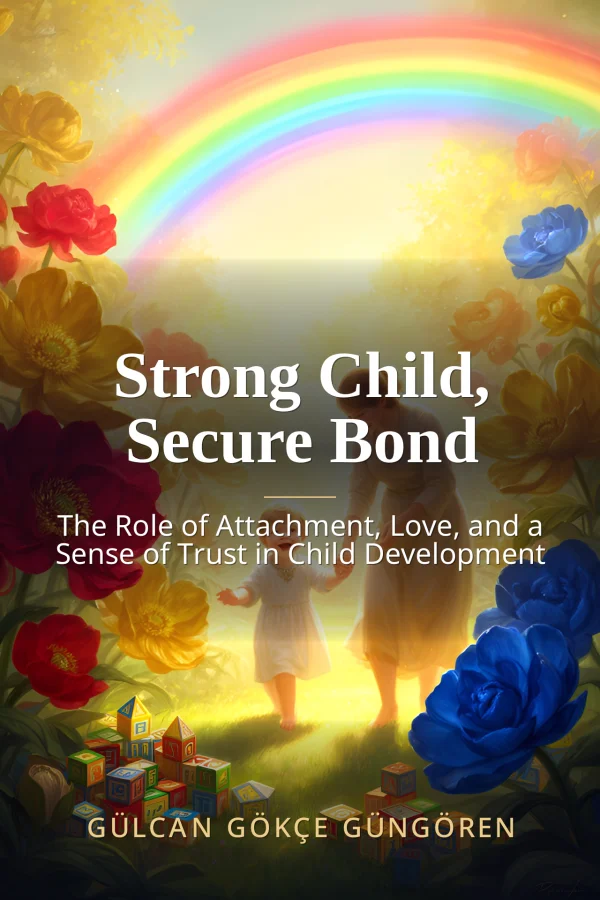
Strong Child, Secure Bond: The Role of Attachment, Love, and a Sense of Trust in Child Development
Gülcan Gökçe Güngören
- Category Child Development
- Format PDF
- Size 4.3 MB
- Added 02.04.2025
- Views 279
Strong Child, Secure Bond explores how the earliest relationships between a child and their caregivers shape emotional development, behavior, and the capacity to trust. Drawing on attachment theory, Gülcan Gökçe Güngören explains what a secure bond looks like in everyday life and why it matters far beyond infancy. The book connects concepts such as love, trust, and responsiveness to the practical realities of raising and caring for children, showing how consistent caregiving becomes the foundation on which a child builds confidence and resilience.
Readers will find clear explanations of attachment styles, the role of sensitive and responsive parenting, and the ways early experiences influence later relationships and emotional regulation. The author addresses common questions and worries parents and educators bring to this subject, offering a grounded perspective rather than quick formulas. Each chapter links theory to observable behavior, helping readers recognize signals of security or insecurity in children and respond in ways that strengthen the relationship.
The book is written for parents, caregivers, teachers, and students of child development who want a thoughtful introduction to attachment and its practical implications. It treats love and trust not as vague ideals but as everyday actions that can be understood and improved. Readers looking for a balanced, accessible guide to building secure bonds with children will find useful insight here, along with a framework for reflecting on their own caregiving practices.
Read the Book
If the PDF does not appear, open it in a new tab.
Table of Contents
- Chapter 1 — The Foundation of Trust: What Is Attachment? 3p. 3
- CHAPTER 1p. 5
- CHAPTER 2p. 10
- CHAPTER 3p. 16
- CHAPTER 4p. 20
- CHAPTER 5p. 25
- CHAPTER 6p. 29
- CHAPTER 7p. 34
- CHAPTER 8p. 39
- CHAPTER 9p. 43
- CHAPTER 10p. 49
- CHAPTER 11p. 53
- CHAPTER 12p. 59
A Chapter from the Book: Chapter 1 — The Foundation of Trust: What Is Attachment? 3
CHAPTER 1 The Foundation of Trust: What Is Attachment? Think of the last time a child in your care — your own, a niece or nephew, a neighbour's kid you were watching for an afternoon — hurt themselves. Maybe they fell off a chair, maybe another child took their toy, maybe they simply woke up grumpy and out of sorts. What did they do in that moment? Where did they go? If you've spent any time around young children, the answer is usually the same. They look for you. They scan the room for a face they know, and once they find it, they either melt into tears, reach up to be held, or shuffle over to stand close to your leg. Only then, once they've checked in, do they seem able to settle. The tears come, or they calm down, and eventually they get back to playing. That small moment, the looking and the finding, is the whole subject of this chapter. The shape of it changes with the child, but the pattern is remarkably steady. A toddler in a busy playgroup will stop every few minutes to glance back at their parent, then carry on. A four-year-old at a birthday party will wander off confidently into the crowd, then return to the adult's side to check that the side is still there, then wander off again. A six-year-old starting school will be cheerful at the gate — and then have a hard evening at home, as if all the brave standing-around had to come out somewhere. Older children do it in quieter ways. They ask what time you'll be home. They want to know whether you'll be there after practice. They phone for no particular reason. In every version, the child is doing the same thing: checking that their safe person is reachable. So put it to yourself directly. When something goes wrong for a child, or feels scary, or just feels a bit too much — do they come to you? Not whether they should, or whether you'd want them to. Whether they do. That question, asked gently of yourself, is a more useful starting place than any theory. Why they come to you at all It helps to notice something obvious that adults tend to forget. A young child cannot make themselves safe. They can't regulate their own nervous system yet; they can't talk themselves down, put their own needs into words, or wait calmly for an uncertain thing to resolve itself. A child is born with a system that is designed to borrow calm from someone else. When a baby is frightened, they don't have a way of reasoning with the fear. What they have is a cry, and a body that settles when a familiar person picks them up.
That borrowing is not a weakness or a habit we're supposed to train away early. It's the mechanism working as it should. The child signals, the adult responds, and something comes down. The heart rate settles. The breathing slows. The world shrinks from overwhelming back to manageable. Over a great many repetitions, this is where a child's sense of the world being a fundamentally okay place gets built — not from being told it is okay, but from having had it demonstrated, over and over, at moments when things felt very much not okay. Attachment describes this link, and the patterns that grow out of it. It's the answer to a quiet question every child is asking in one form or another: when I need someone, will someone come? The answer doesn't get to be verbal for a long time. It gets to be experienced. What's happening underneath Here's where a great deal turns out to be happening quietly in the background. When you respond calmly to a frightened child, you aren't just solving the practical problem — the bumped knee, the snatched toy. You're helping their body learn what to do with a big feeling. They feel the surge, they bring it to you, and you handle it with them until it passes. Slowly, they take in the pattern. Strong feeling comes, getting close helps, the feeling passes. That's not a moral lesson. It's the shape of relief, learned in the body before it can ever be said in words. And the world gets read through that shape. A child who has repeatedly been helped with difficult moments doesn't conclude the world is safe because someone explained it to them. They conclude it because their body has a memory of being met in those moments. When something new and uncertain arrives, they come with a default expectation that they can handle it with help. The expectation is quiet and doesn't announce itself. It's just the water the child is swimming in. The tricky part is that it repeats. This isn't a lesson learned once and then put on a shelf. Every minor bumped knee, every loud noise, every bedtime, every drop-off at the school gate is another round of the same exchange. The child signals, looks for the answer, and the answer either comes back or it doesn't. And a child's whole working model of how people are — of whether the world is reachable, of whether their own distress is worth answering — gets tuned a little more with each round. That's why the ordinary days do the work. There's no single big moment that establishes trust; there are hundreds of small ones. And with a child, this is also why it's not that any one hard moment ruins things.
This section is a preview taken from the book (about 927 words). To continue, read the book or download the PDF.
Book Details
- Book
- Strong Child, Secure Bond: The Role of Attachment, Love, and a Sense of Trust in Child Development
- Author
- Gülcan Gökçe Güngören
- Category
- Child Development
- Language
- English
- Format
- PDF · 4.3 MB
- Pages
- 63
- Words
- about 23,662
- Chapters
- 13
- Published
- Gülcan Gökçe Güngören · 02.04.2025
- Access
- Free to read and download; for personal use only, all rights belong to the author.
Frequently Asked Questions
Is the PDF of Strong Child, Secure Bond: The Role of Attachment, Love, and a Sense of Trust in Child Development free?
Yes. Strong Child, Secure Bond: The Role of Attachment, Love, and a Sense of Trust in Child Development can be read and downloaded for free on this site; no sign-up or payment is required.
How many pages is Strong Child, Secure Bond: The Role of Attachment, Love, and a Sense of Trust in Child Development?
Strong Child, Secure Bond: The Role of Attachment, Love, and a Sense of Trust in Child Development has 63 pages and about 23,662 words.
Which devices can I read Strong Child, Secure Bond: The Role of Attachment, Love, and a Sense of Trust in Child Development on?
It is a PDF; you can read it in your browser on a phone, tablet or computer, or download it and open it offline.
Who is the author of Strong Child, Secure Bond: The Role of Attachment, Love, and a Sense of Trust in Child Development?
Strong Child, Secure Bond: The Role of Attachment, Love, and a Sense of Trust in Child Development was written by Gülcan Gökçe Güngören; it is listed in the Child Development category.
Similar Books
 Anxiety and Fear in Children: Understanding Worries, Building Confidence, and Supporting Psychological Resilience
Gülcan Gökçe Güngören
 Children with Strong Emotional Intelligence: Recognizing Emotions, Building Empathy, and Self-Management Skills
Gülcan Gökçe Güngören
 Minds Growing Through Play: The Power of Play on Intelligence, Creativity, and Social Development
Gülcan Gökçe Güngören
 Anger and Behavioral Problems in Children: A Guide to Understanding Challenging Behaviors from Tantrums to Defiance
Gülcan Gökçe Güngören
 Future-Ready Children: Raising Creativity, Flexibility and Life Skills in a Changing World
Gülcan Gökçe Güngören
 The Codes of the Child's Mind: Understanding Children's World of Thought, Emotion, and Behavior
Gülcan Gökçe Güngören